Remote-Controlled Ball-Collecting Boat
A university team project to design and build a remotely controlled boat that collects floating balls from a 1.2 × 1.2 m water tank.
- My role
- Ship builder · Hulls, bridge and assembly
- Status
- Built and tested prototype
- Tools & processes
- Fusion 360 · Vacuum forming · Laser cutting · 3 mm MDF
- Outcome
- 10 balls collected in 25 seconds during pool testing
The challenge
As part of a university engineering project at King’s College London, our team designed and built a remotely controlled boat capable of collecting floating balls.
The main challenges were keeping the boat stable, protecting the electronics from water and making the structure lightweight enough to manoeuvre effectively.
My contribution
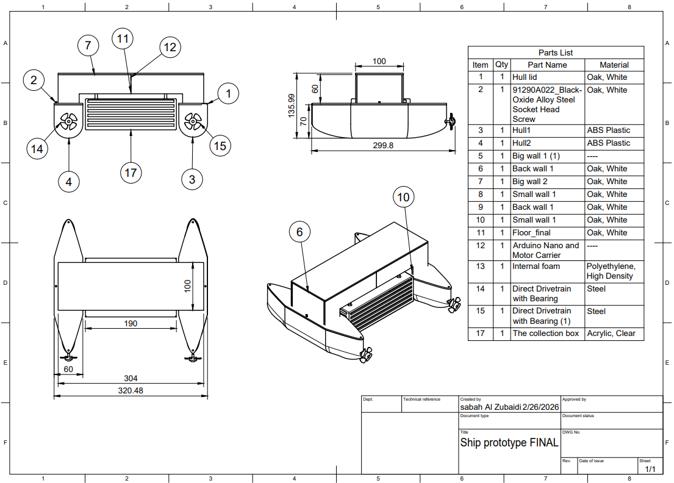
I was responsible for building the two hulls and designing, laser-cutting and assembling the bridge connecting them.
I also installed the drivetrain and propellers, fitted and sealed the shaft bearings, and helped test the boat for leaks and stability.
Design and fabrication
A catamaran structure
Two separated hulls provided a stable platform with space for the collection mechanism between them.
Vacuum-formed hulls
I shaped foam blocks using a hot-wire cutter, then vacuum-formed plastic over them to create lightweight, water-resistant shells.
A laser-cut bridge
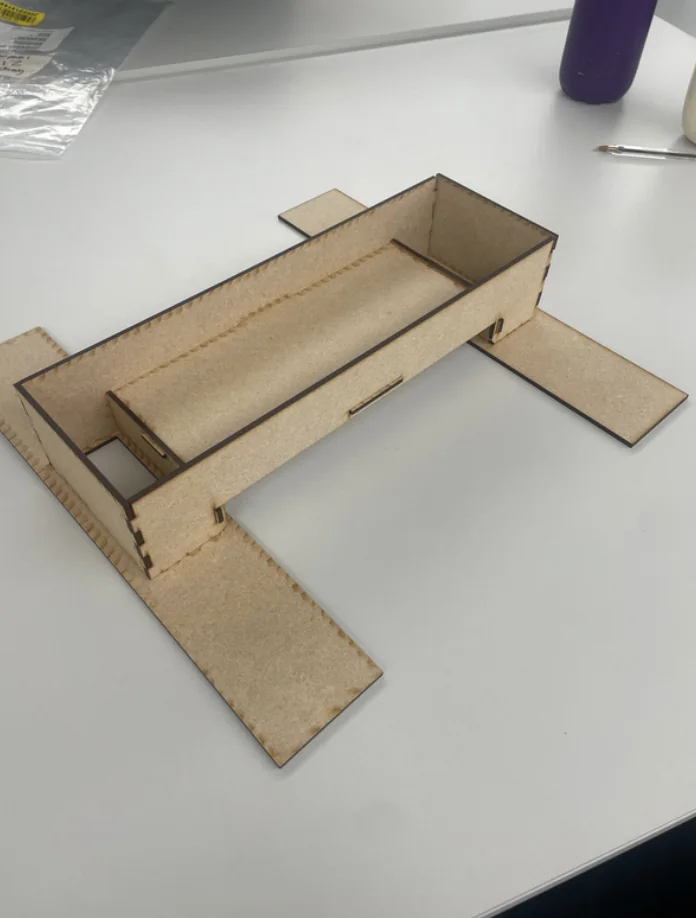
I designed eight interlocking components in Fusion 360, using 3 mm MDF and finger joints for accurate alignment and straightforward assembly.
Protecting the electronics
The bridge kept the Arduino and batteries elevated. A hinged transparent acrylic cover provided splash protection while allowing access for maintenance.
Testing on the water
10 ballsin 25 seconds
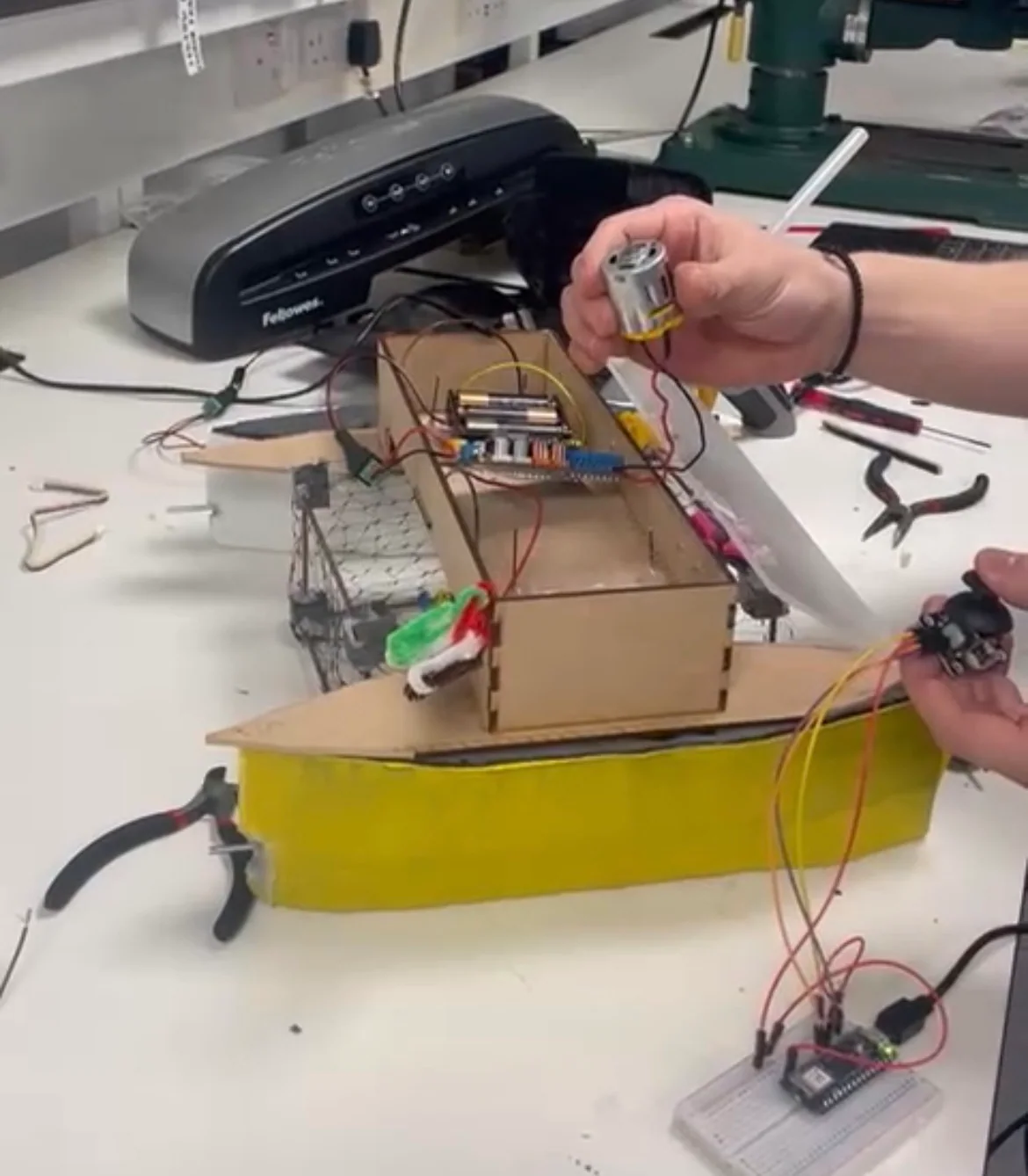
The complete timed test collected 10 balls in 25 seconds. This 11-second excerpt shows part of that test, rather than the full run.
The boat moves towards coloured floating balls and collects them between its hulls.